Basics of HIPPA Complaince
HIPPA can be difficult to understand so lets break it down into a simplified first step to understanding.
Haylee Short
12/28/20252 min read


What is HIPAA?
Signed into law in 1996, the Health Insurance Portability and Accountability Act (HIPAA) created a national standard for how we handle healthcare transactions, identifiers, and data security. Recognizing the risks of a digital world, Congress included mandates for federal privacy protections for all identifiable health information. Today, these standards are overseen and enforced by the Office for Civil Rights (OCR), the agency responsible for ensuring that your health data remains both private and secure.
The Police and the Architects of HIPPA
NIST (The Architects)
The National Institute of Standards and Technology (NIST) is a non-regulatory agency. They don’t hand out fines, but they provide the "blueprints."
What they do: They create the highly detailed cybersecurity frameworks and technical standards that help organizations actually meet HIPAA requirements.
Their role: When the OCR says "you must encrypt data," NIST is the agency that explains exactly how to do it so it counts as secure.
The OCR (The Police)
The Office for Civil Rights (OCR) is a department within Health and Human Services (HHS). They are the primary enforcers of HIPAA.
What they do: They investigate complaints, conduct compliance audits, and issue those massive multi-million dollar fines you see in the news.
Their role: If you have a data breach, you report it to the OCR.
The Breakdown of HIPAA Rules
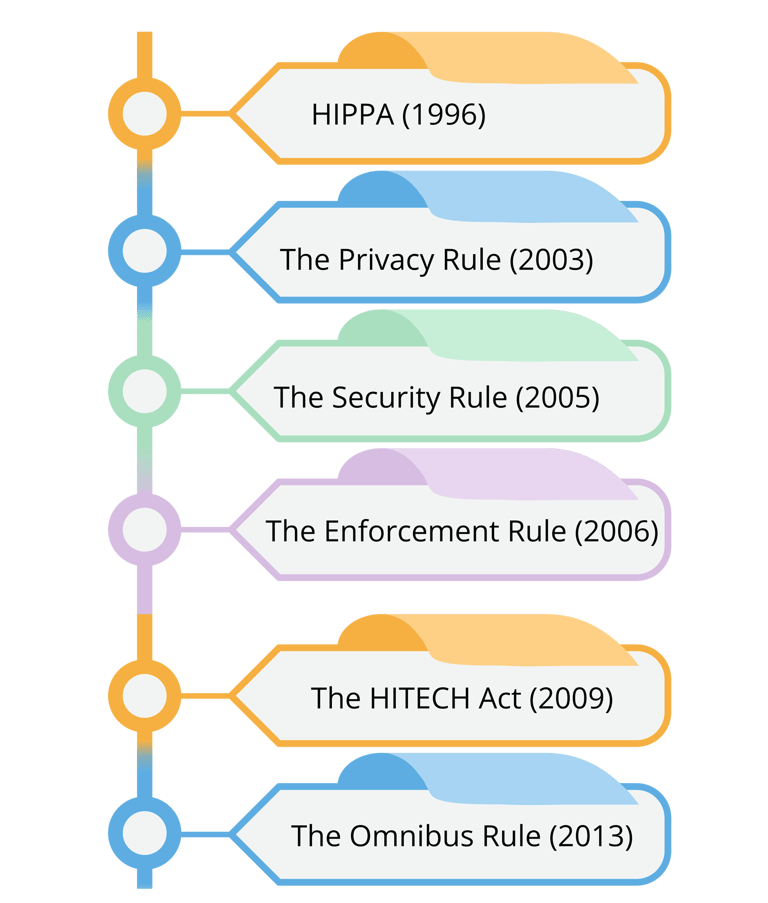
HIPAA isn’t a single document; it’s a collection of rules added over time to keep pace with technology and patient rights.
The Privacy Rule (2003): Sets the national standards for when and how your Protected Health Information (PHI) can be shared, while giving you the right to see and correct your own medical records.
The Security Rule (2005): Establishes the administrative, physical, and technical safeguards—like encryption and locked server rooms—needed to protect health information specifically in electronic form.
The Enforcement Rule (2006): Sets the "laws of the land" for how the OCR investigates HIPAA complaints and determines the financial penalties for healthcare providers who fail to comply.
The HITECH Act (2009): Technically a separate law, it gave HIPAA "teeth" by significantly increasing the fines for data breaches and mandating that technology vendors follow the rules.
The Omnibus Rule (2013): A major update that closed loopholes by making third-party "Business Associates" directly liable for compliance and strengthening patient privacy rights.
The Breach Notification Rule: Requires healthcare organizations to notify patients, the government, and sometimes the media whenever unencrypted health data is lost or stolen.